Lucky 15 Bet Explained: How 15 Wagers Are Structured Across 4 Selections, How Payouts Are Calculated, and How It Compares to Trixie and Yankee
What Is a Lucky 15 Bet?
A Lucky 15 is a full cover bet placed across four selections. It combines every possible combination of those four selections into 15 separate wagers: four singles, six doubles, four trebles, and one fourfold accumulator. Each wager is staked independently, meaning a return is generated from any selection that wins — even just one.
The "full cover" element is what separates a Lucky 15 from a standard accumulator. An accumulator on four selections requires all four to win for any return. A Lucky 15 activates multiple wagers from a single winner upward, making it a structure designed for bettors who want coverage across outcomes rather than all-or-nothing exposure.
This structure is purely combination-based — it has nothing in common with draw-format prize systems. Users looking for mobile access options can explore 1xbet yukle apk download, while a Lucky 15 generates returns through settled sports results, with each wager calculated individually by the bookmaker.
The Origin of Lucky 15 and Full Cover Bets in British Betting Tradition
The Lucky 15 is a product of British betting tradition, where combination bets covering all permutations of a selection pool have been offered by licensed bookmakers since the mid-twentieth century. The format was designed specifically for horse racing, where multiple races could be selected across an afternoon card and each-way terms made partial returns viable even without a winner.
Full cover bets — Patent (3 selections), Trixie (3 selections, no singles), Yankee (4 selections, no singles), Lucky 15 (4 selections with singles), Lucky 31 (5 selections), and Lucky 63 (6 selections) — form a structured family of combination wager types that remain standard offerings at bookmakers across the UK, Ireland, and internationally. The naming convention ("Lucky") indicates full cover bets that include singles at every selection level.
How a Lucky 15 Is Structured: All 15 Wagers Broken Down
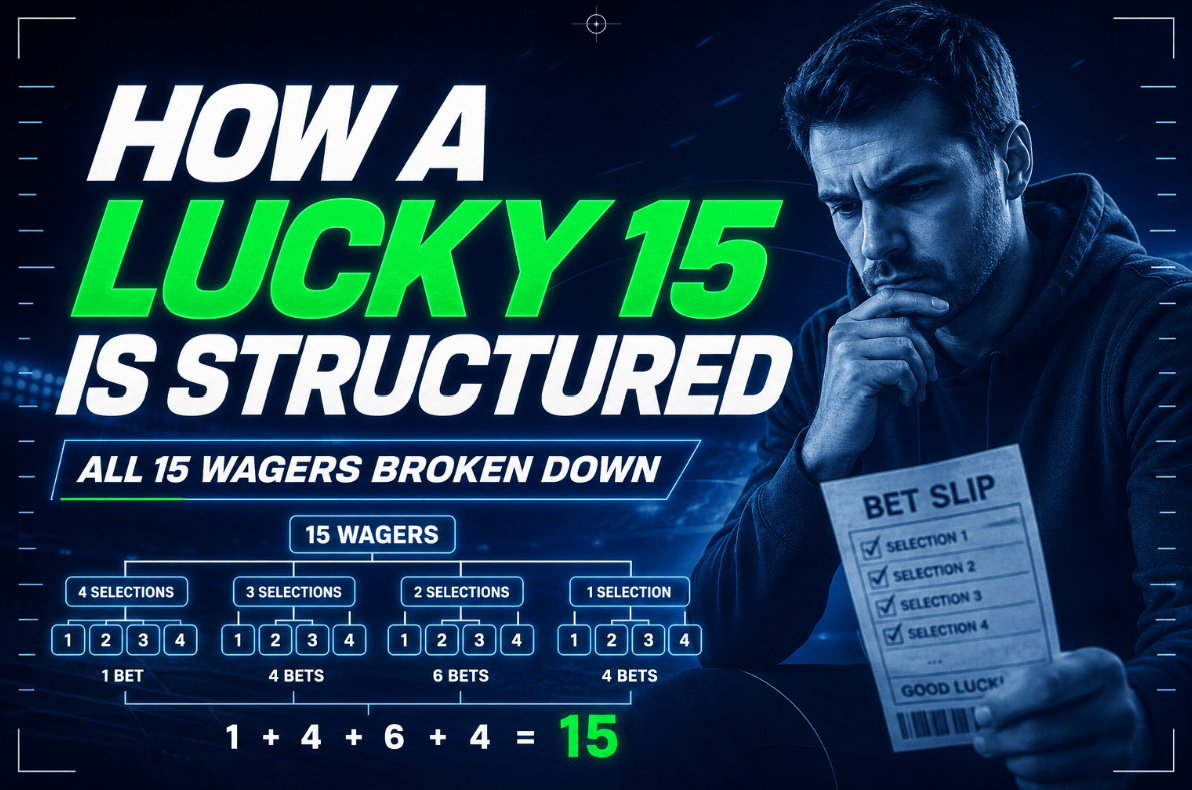
The Four Singles
A single is a standalone wager on one selection to win. A Lucky 15 on four selections (A, B, C, D) includes four singles: one on A, one on B, one on C, and one on D. Each single returns independently of the other selections.
The Six Doubles
A double combines two selections into one wager — both must win to return. With four selections, there are six possible two-selection combinations: AB, AC, AD, BC, BD, and CD. All six are included in a Lucky 15.
The Four Trebles
A treble combines three selections — all three must win to return. With four selections, there are four possible three-selection combinations: ABC, ABD, ACD, and BCD. All four are included.
The One Fourfold Accumulator
The fourfold accumulator combines all four selections into a single wager. All four must win to return. It carries the highest potential payout of any wager in the Lucky 15 but requires a clean sweep.
Why the Total Always Equals 15 Wagers
The total wager count is mathematically fixed by combinatorics. With four selections:
- Combinations of 1 from 4 = 4 singles
- Combinations of 2 from 4 = 6 doubles
- Combinations of 3 from 4 = 4 trebles
- Combinations of 4 from 4 = 1 fourfold
- Total: 15 wagers
This is why the bet is called a Lucky 15 — not a branding choice but an accurate count of the wagers placed.
Minimum Requirements to Get a Return on a Lucky 15
A Lucky 15 returns on any number of winning selections from one upward. The single on the winning selection pays regardless of whether any other selection wins. This is the key structural advantage over a Yankee (which requires a minimum of two winners to return anything) and over a fourfold accumulator (which requires all four).
One winner generates a return from one single. Two winners generate returns from two singles and one double. Three winners generate returns from three singles, three doubles, and one treble. Four winners activate all 15 wagers.
How Lucky 15 Payouts Are Calculated
All payout examples below use a £1 unit stake per wager, producing a £15 total stake across the full Lucky 15. Odds are expressed in decimal format.
Step-by-Step Example: All Four Selections Win
Selections A (2.50), B (3.00), C (2.00), D (4.00) — all win.
Active wagers: all 15.
- Singles: (1 × 2.50) + (1 × 3.00) + (1 × 2.00) + (1 × 4.00) = £11.50
- Doubles: (2.50×3.00) + (2.50×2.00) + (2.50×4.00) + (3.00×2.00) + (3.00×4.00) + (2.00×4.00) = 7.50 + 5.00 + 10.00 + 6.00 + 12.00 + 8.00 = £48.50
- Trebles: (2.50×3.00×2.00) + (2.50×3.00×4.00) + (2.50×2.00×4.00) + (3.00×2.00×4.00) = 15.00 + 30.00 + 20.00 + 24.00 = £89.00
- Fourfold: 2.50 × 3.00 × 2.00 × 4.00 = £60.00
- Total return: £209.00 | Net profit: £194.00
Step-by-Step Example: Three of Four Selections Win
Selections A (2.50), B (3.00), C (2.00) win. D loses.
Active wagers: 3 singles (A, B, C), 3 doubles (AB, AC, BC), 1 treble (ABC). D's single, all doubles containing D, and the fourfold return nothing.
- Singles: 2.50 + 3.00 + 2.00 = £7.50
- Doubles: (2.50×3.00) + (2.50×2.00) + (3.00×2.00) = 7.50 + 5.00 + 6.00 = £18.50
- Treble: 2.50 × 3.00 × 2.00 = £15.00
- Total return: £41.00 | Net profit: £26.00
Step-by-Step Example: Two of Four Selections Win
Selections A (2.50) and B (3.00) win. C and D lose.
Active wagers: 2 singles (A, B), 1 double (AB). All other combinations include a loser and return nothing.
- Singles: 2.50 + 3.00 = £5.50
- Double: 2.50 × 3.00 = £7.50
- Total return: £13.00 | Net loss: £2.00
Step-by-Step Example: Only One Selection Wins
Selection A (2.50) wins. B, C, D all lose.
Active wagers: 1 single (A only). All combinations of two or more selections require at least one loser and return nothing.
- Single: £2.50
- Total return: £2.50 | Net loss: £12.50
How Total Stake Is Calculated Across All 15 Wagers
At a £1 unit stake, the total cost of a Lucky 15 is always 15 × £1 = £15. At £2 per wager it is £30; at £5 per wager it is £75. The unit stake multiplies uniformly across all 15 wagers — there is no tiered staking within the bet type. Always confirm the unit stake before placing; bookmaker interfaces may default to a per-bet or total-stake entry field.
Lucky 15 Bonuses: How Bookmakers Enhance the Bet
Many bookmakers attach conditional bonuses to Lucky 15 bets that enhance returns in two specific scenarios.
Key bonus structures across the industry:
- One winner consolation bonus: If exactly one selection wins, the single payout is enhanced — commonly by 25% to 100% — as compensation for a near-miss on combination wagers.
- All four winners bonus: If all four selections win, the total return is enhanced — commonly by 10% to 25% added to the gross payout.
- How bonuses are applied: Bonuses apply to the return from qualifying wagers, not to the total stake. A 25% one-winner bonus on a £2.50 single return adds £0.63, producing £3.13 total.
- Bonus availability varies: Not all bookmakers offer these; some offer one but not both. Check the specific operator's Lucky 15 terms before placing.
- Bookmaker-specific thresholds: Some operators require minimum odds on each selection (e.g., evens or greater) for the bonus to apply.
One Winner Consolation Bonus
When only one selection wins, the Lucky 15 produces a return from a single wager only — 14 of 15 wagers are lost. The consolation bonus acknowledges this outcome. At a typical 25% uplift, a £5.00 single return becomes £6.25. At 100% uplift (offered by some bookmakers), the single pays double its standard odds return.
All Four Winners Bonus: How the Enhanced Payout Works
When all four selections win, all 15 wagers return and the gross payout is already substantial. The all-winners bonus — commonly 10% — is applied to the gross return before or after the stake is deducted depending on the operator's terms. On a £209.00 gross return, a 10% bonus adds £20.90, producing £229.90 before stake deduction. Always verify whether the bonus percentage applies to returns or to profit.
For players who prefer structured prize tiers and guaranteed prize values, draw-based formats such as online loto operate on entirely different mechanics — prizes are fixed by tier, not calculated from odds combinations.
Lucky 15 vs. Trixie: Key Structural Differences
A Trixie covers three selections across 4 wagers: three doubles and one treble. It carries no singles, meaning at least two selections must win to generate any return.
A Lucky 15 covers four selections across 15 wagers and includes singles at every level. It requires only one winner to return. The Lucky 15 costs more (15 wagers vs. 4) but provides coverage that a Trixie structurally cannot offer: return from a single winner, and the additional fourfold accumulator payout when all four win.
If the bettor's four selections contain one strong banker and three speculative picks, the Lucky 15 provides insurance through the singles that a Trixie entirely lacks.
Lucky 15 vs. Yankee: What the Yankee Leaves Out
A Yankee covers four selections across 11 wagers: six doubles, four trebles, and one fourfold. It excludes all singles. This means the Yankee costs £11 at £1 per wager (vs. £15 for the Lucky 15) but requires a minimum of two winners to return anything at all.
The Lucky 15 adds the four singles that the Yankee omits. Those four additional wagers cost £4 extra at £1 stakes but make the difference between a complete loss and a small return when only one selection wins. For horse racing, where a single winner across a card is a common outcome, this distinction is significant.
Lucky 15 vs. Patent: How Three-Selection Full Cover Compares
A Patent is the three-selection equivalent of the Lucky 15. It covers three selections across 7 wagers: three singles, three doubles, and one treble. Like the Lucky 15, it includes singles and returns on one winner.
The Lucky 15 adds a fourth selection, which increases the wager count from 7 to 15 and adds the fourfold accumulator as a potential high-payout wager. The Patent is cheaper (7 wagers vs. 15) but offers a lower ceiling — the maximum return from three winners at the same odds is smaller than four winners in a Lucky 15.
Full Cover Bet Family Comparison Table: Patent, Trixie, Yankee, Lucky 15, Lucky 31
|
Bet Name |
Selections |
Singles |
Doubles |
Trebles |
Fourfolds |
Fivefolds |
Total Wagers |
Min. Winners for Return |
|
Patent |
3 |
3 |
3 |
1 |
— |
— |
7 |
1 |
|
Trixie |
3 |
0 |
3 |
1 |
— |
— |
4 |
2 |
|
Yankee |
4 |
0 |
6 |
4 |
1 |
— |
11 |
2 |
|
Lucky 15 |
4 |
4 |
6 |
4 |
1 |
— |
15 |
1 |
|
Lucky 31 |
5 |
5 |
10 |
10 |
5 |
1 |
31 |
1 |
|
Lucky 63 |
6 |
6 |
15 |
20 |
15 |
6 |
63 |
1 |
Lucky 15 Payout Scenario Table: All Win to None Win
All figures use £1 per wager (£15 total stake). Selections A=2.50, B=3.00, C=2.00, D=4.00.
|
Scenario |
Winning Selections |
Active Wagers Returning |
Total Return |
Net Profit / Loss |
|
All four win |
A, B, C, D |
15 of 15 |
£209.00 |
+£194.00 |
|
Three win |
A, B, C |
7 of 15 |
£41.00 |
+£26.00 |
|
Two win |
A, B |
3 of 15 |
£13.00 |
−£2.00 |
|
One wins |
A only |
1 of 15 |
£2.50 |
−£12.50 |
|
None win |
— |
0 of 15 |
£0.00 |
−£15.00 |
Lucky 15 vs. Yankee vs. Trixie vs. Patent: Stake and Return Comparison
|
Bet Type |
Selections |
Total Wagers |
Min. Stake (£1/wager) |
One Winner Return (A at 2.50) |
All Winners Return (A=2.50, B=3.00, C=2.00, D=4.00) |
|
Patent |
3 |
7 |
£7 |
£2.50 |
£55.00* |
|
Trixie |
3 |
4 |
£4 |
£0.00 |
£43.50* |
|
Yankee |
4 |
11 |
£11 |
£0.00 |
£209.00 (no singles) |
|
Lucky 15 |
4 |
15 |
£15 |
£2.50 |
£209.00 |
Patent and Trixie use only three selections (A, B, C); fourfold not applicable.
How Each-Way Lucky 15 Works
How Each-Way Terms Apply to Singles, Doubles, Trebles, and Fourfold
An each-way bet splits every wager into two equal parts: a win bet and a place bet. An each-way Lucky 15 therefore consists of 30 wagers (15 win + 15 place) at double the stated unit stake.
Place terms — the fraction of win odds paid for a place finish, and the number of places covered — are set by the bookmaker for each race. Standard horse racing terms are 1/4 odds for places 1–3 in fields of 8 or more runners. In an each-way Lucky 15, a placed (but not winning) selection contributes its place odds to the place half of every combination that includes it.
Step-by-Step Each-Way Lucky 15 Payout Example
Selection A wins at 5.00 (place terms: 1/4 odds = 2.00 for place). Selections B, C, D are placed but do not win.
At £1 each-way (£2 per wager, £30 total):
- Win half: Only A wins — 1 win single returns £5.00. All other win wagers lose (B, C, D didn't win).
- Place half: A, B, C, D all placed. All 15 place wagers return. Place odds: A=2.00, B=1.50 (3.00 at 1/4), C=1.25 (2.00 at 1/4), D=1.75 (4.00 at 1/4).
- Place singles: 2.00+1.50+1.25+1.75 = £6.50
- Place doubles: (2.00×1.50)+(2.00×1.25)+(2.00×1.75)+(1.50×1.25)+(1.50×1.75)+(1.25×1.75) = 3.00+2.50+3.50+1.88+2.63+2.19 = £15.70
- Place trebles: (2.00×1.50×1.25)+(2.00×1.50×1.75)+(2.00×1.25×1.75)+(1.50×1.25×1.75) = 3.75+5.25+4.38+3.28 = £16.66
- Place fourfold: 2.00×1.50×1.25×1.75 = £6.56
- Total place return: £45.42
- Total combined return: £5.00 + £45.42 = £50.42 | Net profit: +£20.42
Each-way Lucky 15 bets are common in horse racing precisely because placed horses in strong-field races can generate meaningful returns across all 15 place wagers even when nothing wins outright.
Lucky 15 in Horse Racing: Why It Is Most Commonly Used There
Horse racing is the natural home of the Lucky 15 for three structural reasons. First, afternoon race cards typically feature five or more races, giving bettors four natural selection slots. Second, each-way markets are standard in horse racing, making the place-bet dimension of each Lucky 15 wager immediately applicable. Third, form-based selection makes partial results — one or two winners from four picks — a realistic and common outcome rather than an edge case.
In football or other sports, the Lucky 15 is used but less dominant. Match result markets don't carry each-way terms, and the odds structure across four games tends to produce either strong all-winning returns or near-total losses without the middle-ground return distribution that horse racing provides.
How Bookmakers Handle Void and Non-Runner Selections in a Lucky 15
A void selection — one that is cancelled, withdrawn, or declared a non-runner before the event — is removed from the Lucky 15 and all wagers containing that selection are recalculated without it.
In practice, this means wager counts reduce. A double containing one void selection becomes a single on the remaining selection. A treble containing one void becomes a double. The fourfold containing one void becomes a treble. The unit stake for each affected wager is still settled, and the bookmaker pays the reduced combination at the original odds of the surviving selections.
If two selections are void, the Lucky 15 reduces to a Patent (7 wagers across 3 selections). If three are void, it reduces to a single. Rules on void selections are set by the bookmaker and should be confirmed before placing in sports with high non-runner risk such as horse racing.
Common Mistakes When Placing a Lucky 15 Bet
- Confusing unit stake with total stake. A £5 Lucky 15 means £5 per wager and £75 total exposure — not £5 total. Bookmaker interfaces vary in how they present this; always confirm total stake before confirming.
- Forgetting each-way doubles the stake. An each-way Lucky 15 at £1 per wager costs £30, not £15. Each wager splits into two, not one.
- Assuming bonus availability. Not all bookmakers offer one-winner consolation or all-winners bonuses. Treating them as guaranteed when calculating expected return leads to miscalculation.
- Ignoring non-runner rules. In horse racing, non-runners reduce the bet and change return calculations. A £75 Lucky 15 with one non-runner does not automatically refund £20 for the removed selection — the affected wagers are simply settled as smaller combinations.
- Selecting low-odds selections expecting value. A Lucky 15 on four selections all priced near evens (2.00) produces a modest fourfold of 16.00. The 15-wager structure costs more in total stake than a corresponding accumulator, and only the combination returns offset that cost when all win.
- Overlooking place terms in each-way Lucky 15. Place terms vary by race field size and bookmaker. A 1/5 place term instead of 1/4 meaningfully reduces all 15 place wager returns.
FAQ
How many bets are in a Lucky 15?
A Lucky 15 consists of exactly 15 wagers: four singles, six doubles, four trebles, and one fourfold accumulator. This count is fixed by combinatorial mathematics applied to four selections and does not change.
What is the minimum number of winners needed to get a return from a Lucky 15?
One winner. The single on that selection returns at its stated odds. All other wagers that include losing selections return nothing, but the single on the one winner is settled as a win.
How does a Lucky 15 differ from a Yankee?
A Yankee covers the same four selections as a Lucky 15 but excludes all four singles, producing 11 wagers instead of 15. The Yankee requires a minimum of two winners to return anything. The Lucky 15 adds the four singles — at an extra cost of £4 at £1 stakes — and returns from a single winner.
What bookmaker bonuses apply to a Lucky 15?
The two standard bonuses are a consolation bonus (typically 25%–100% uplift on the return when exactly one selection wins) and an all-winners bonus (typically 10%–25% uplift on total returns when all four selections win). Availability and rates vary by bookmaker and are not universal.
How does a void selection affect a Lucky 15?
A void or non-runner selection is removed from the bet. Every wager containing the void selection is recalculated without it: doubles become singles, trebles become doubles, and the fourfold becomes a treble. The remaining wagers are settled normally at the surviving selections' odds.
Is an each-way Lucky 15 the same as two separate Lucky 15 bets?
Functionally yes — an each-way Lucky 15 is a win Lucky 15 and a place Lucky 15 run simultaneously, doubling the total number of wagers to 30 and the total stake to 30× the unit stake. The win half and place half are settled independently according to win and place results.
Can a Lucky 15 be placed on sports other than horse racing?
Yes. Any sport with four distinct selections can accommodate a Lucky 15. However, most sports markets don't carry each-way terms, and the full-cover structure is most naturally suited to multi-race cards where partial results are common. In football and other sports, the bet functions identically but loses the each-way dimension.
Gambling involves risk. A Lucky 15 exposes the bettor to 15 simultaneous wagers; the total stake is always 15× the unit stake. Set a budget before placing and never stake more than you can afford to lose. If gambling causes problems, contact your national responsible gambling support service. 18+.
 Print Version
 Send to a friend